
Meet the Blood Angel of Nollywood: Katherine on Special Effects, Creativity and Finding Her Place in Film
She is a Nigerian beauty and special effects makeup artist whose work spans beauty makeup, special effects, sculpting, prosthetics and face painting. Her work involves creating transformations that can make an audience forget, even if only for a few seconds, that what they are looking at is makeup.
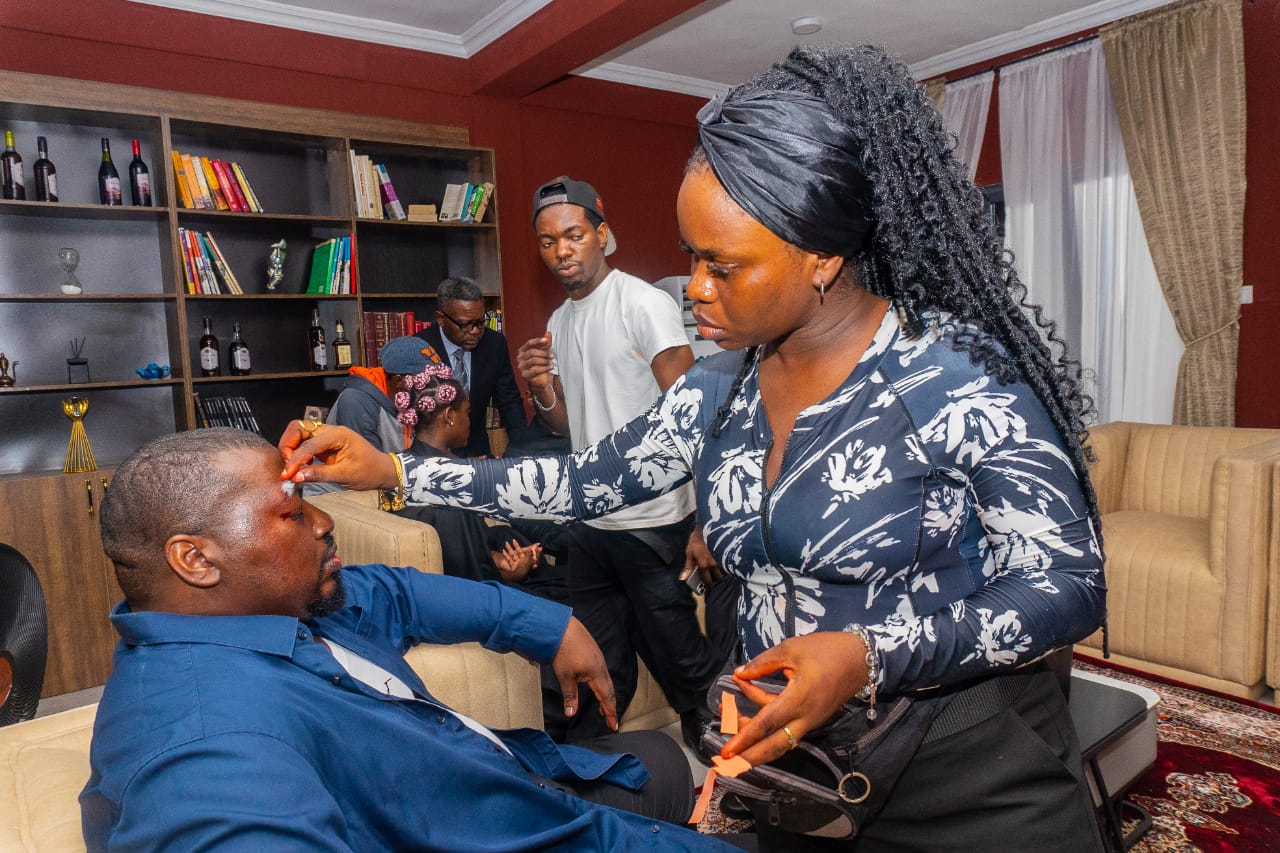
There is a particular reaction Katherine gets whenever she walks onto a film set carrying blood. People who have worked with her already know what is coming, and sometimes, before she has even started, someone will look at her and say, “Not again.” Over time, the joke has become part of her identity on set, with some of her colleagues calling her the “Blood Angel” because of how often blood, wounds, bruises and other gruesome effects feature in her work.
For Katherine, however, the blood has never been about being dark. It is about creating something that did not exist before and figuring out how to make an idea believable on the human body.
She is a Nigerian beauty and special effects makeup artist whose work spans beauty makeup, special effects, sculpting, prosthetics and face painting. Her work involves creating transformations that can make an audience forget, even if only for a few seconds, that what they are looking at is makeup.
But getting to this point was not something Katherine planned from the beginning. She studied microbiology at the university. Her family had their own expectations of the career she would eventually pursue, and nothing about her academic background suggested that she would end up building a career around blood, prosthetics and creatures.
Yet somewhere along the way, she found something that felt more like her.
Today, she describes SFX as a space where she can take an idea and bend it into reality, and that freedom to create has become one of the biggest reasons she continues to love the work.
From Beauty Makeup to Special Effects
Katherine's journey started with beauty makeup. She had always been interested in makeup and anything that involved putting something on the face, and after secondary school, she began saving money so she could buy basic products such as foundation, eye pencils and other makeup items.
Her journey into special effects began in 2017 while she was still in school. She came across an American SFX artist's page and saw a cut(SFX) she had done. Katherine was fascinated by what she saw and immediately wanted to understand how those effects were created because they looked so real.
That curiosity led her into research and constant practice. The more she learned, the more interested she became, especially because SFX gave her the opportunity to create things that were outside the ordinary.
For Katherine, there is something particularly satisfying about taking an idea that exists only in her head and turning it into something people can actually see. However, she also understands that creating believable effects requires more than imagination. An SFX artist has to understand the human body because realism depends on knowing how the body behaves and how different injuries, scars, diseases and other physical changes would actually appear.
Over time, that combination of creativity, research and practice became the foundation of her work.
The Idea Comes Before the Materials
When Katherine begins a project, the idea comes first. The materials come afterwards, and that is especially important in Nigeria, where access to specialised SFX resources can be limited.
According to her, Nigerian artists do not always have the same access to materials that artists in the Western world have, and importing products can also become expensive. That means an SFX artist has to learn how to solve problems and improvise when the exact material needed is unavailable.
“You have to have that skill of improvising,” she explains.
The process therefore begins with asking what she wants to create and then figuring out how to achieve it with the resources available. If the necessary product is available, she uses it, but if it is not, she has to look around and decide what can work as an alternative.
It is a reality that has influenced the way she approaches the craft because there is often no option to simply stop because the perfect product is unavailable. Whatever is available has to be turned into a solution.
This is something Katherine has experienced personally. Before she could afford professional products, she relied heavily on DIY alternatives and used easily accessible materials to practise. She recalls making a substitute for a material she needed by mixing Vaseline and flour, and she also experimented with things such as food colouring and other household products to create blood and different textures.
The point was not to create a perfect professional product immediately. It was to start learning.
The Work Behind a Few Seconds on Screen
One of the things Katherine wishes more people understood is that special effects makeup is rarely as simple as it looks on screen.
An audience might see a wound or a blood effect for a few seconds and assume that the artist simply poured some blood or painted a cut onto the actor. What they do not see is the amount of research, preparation, precision, creativity and technical work that went into those few seconds.
Katherine has encountered this attitude on set, including someone telling her that she could simply “pour blood.”
But, as she explains, it is much more complicated than that.
If she is creating a cut, for example, she has to consider what caused the injury. A knife wound should not look like an axe wound because the two would affect the body differently. If she is creating a scar, she has to consider how old it is and how the body would realistically heal over time.
The same thinking applies when creating a diseased or decayed body. She has to research how a body would look depending on how long it has been in that condition. A body that has been dead for a week will not necessarily look the same as one that has been dead for a month, so the swelling, decay and other physical changes have to correspond with the story.
All of these details are important because the ultimate goal is for the audience to believe what they are seeing.
Katherine wants the audience to understand why the blood is there, where it came from and whether the entire effect makes sense within the reality of the story.
Imagination Is Only Part of the Job
If she had to divide her work between imagination and technical skill, Katherine would give imagination 30 percent and technical work 70 percent.
That may sound surprising for someone whose work involves creating creatures and unusual transformations, but she believes having an idea is only the beginning. The real work comes when she has to figure out how to physically create that idea.
She uses the example of creating a diseased or decayed body. She might have an image in her head of exactly what she wants the body to look like, but then she has to research how swollen the body should be, how far the disease or decay should have progressed and what the physical changes should look like.
After that comes the technical question of how to make it happen.
What materials are available? What can be substituted if the materials are unavailable? How can the artist achieve the desired effect without a huge production budget?
Those questions are part of the work.
For Katherine, imagination gives her the vision, but technical skill allows her to turn that vision into something that can actually exist on screen.
Nollywood Has Grown, But There Is Still More to Explore
Katherine has seen growth in Nollywood's use of special effects makeup. She has noticed improvements in areas such as blood texture and the overall realism of certain effects, and when she looks at some of the work being produced today compared with what existed years ago, she can see that the industry is moving forward.
However, she does not believe Nollywood has reached its full potential.
“We are heading there, but we are not there yet,” she says.
One of the areas she believes still needs more attention is character makeup and practical effects. In her view, Nigeria has a lot of talented artists who want to explore these areas but do not always have the opportunity to do so.
She points to the Western film industry, where character makeup and practical effects are used extensively to create creatures, transformations and other characters that can completely change the way an actor looks.
Those kinds of effects can fascinate audiences because they create something that feels almost impossible, yet is physically present on screen.
Katherine believes Nigerian artists can create that same kind of fascination if they are given the resources and opportunity to explore.
For her, Nollywood also needs to explore genres such as horror more seriously. While the industry has produced many history-based stories, love stories and other familiar genres, she believes horror provides a particularly interesting space for SFX artists because it allows them to create things that are completely outside the ordinary.
There is room to be creative, especially when the story is fictional.
When Creative Vision Meets Production Restrictions
Even when an SFX artist has an idea, however, there is no guarantee that the production will allow them to execute it exactly as planned.
Katherine admits that she has not always had the creative freedom she would have liked on set. Sometimes production rules or restrictions on what can be shown on screen mean that an effect has to be toned down.
She remembers one production where an actor was supposed to commit suicide by shooting himself. Katherine had already planned how the injury to the head and the resulting effect would appear on screen, but she was told that she could not execute it in the way she had envisioned because of restrictions around what could be aired.
The production therefore had to find another way to communicate what had happened without showing the effect as explicitly as she had planned.
For Katherine, experiences like this demonstrate why collaboration between directors and SFX departments is important. She understands that the director ultimately has a role to play in deciding what appears on screen, but she believes productions would benefit from giving special effects artists more room to contribute creatively.
She also believes that Nigerian filmmaking has not fully explored the genres and stories where SFX could make the biggest difference.
There is so much more that could be done if filmmakers were willing to explore practical effects, character makeup and horror beyond the familiar ways they have been presented.
The Problem of Time
Another major challenge is the amount of time given to SFX artists on set.
Katherine says she has never spent more than about an hour working on a transformation on set, largely because productions often do not give SFX departments enough time to complete their work properly.
One of the most intense examples she remembers involved creating a full-body burn. She and her team had to complete the transformation in less than 45 minutes.
The problem is that special effects makeup requires careful blending, especially when prosthetics are involved. The prosthetic needs to blend into the actor's natural skin so that the audience cannot immediately identify where the real skin ends and the artificial material begins.
Without proper blending, the effect becomes obvious.
But blending takes time, and time is often limited on a film set because the actors need to be ready, scenes need to be shot and the production has to keep moving.
So the SFX artist has to work as quickly as possible and deliver an effect that may not have received as much time as it ideally should.
For Katherine, this is another reason why better investment and better production planning are necessary if Nollywood wants to take practical effects to another level.
The Eboras: Eight Creatures and a Lot of Work
One of the most challenging transformations Catherine has worked on involved creatures called Eboras.
In the story, the Eboras were greenish creatures with ears, horns, almost yellowish eyes, long NAILS, folds around their bodies and they also hadhooves.
Creating them was challenging for several reasons, but one of the biggest was that the actors playing the creatures could not simply stand still and look convincing. They had to move.
They had to run.
They had to fight.
That meant the effects had to be designed around the actors' ability to perform.
Katherine and her team had to make adjustments to the hooves so the actors could move comfortably in them, while also making sure that the rest of the transformation did not restrict their movement.
The application itself was also extensive because every part of the actors' bodies had to be painted and detailed. Their eyes had to be handled with safety in mind, and the paints used on their bodies had to be tested because people have different skin types and can react differently to certain products.
Their hair had to be applied, their horns had to be positioned and the pieces attached to their backs had to be placed in ways that would allow them to run, walk and fight.
And there were about eight of them.
It was one of those projects where the work went far beyond simply making someone look like a creature. The effects had to function alongside the performance, which meant Katherine had to think about both appearance and practicality.
Her Favourite Transformation Is a Severed Head
For all the creatures and complicated effects she has worked on, Katherine's favourite transformation is actually creating severed heads.
She describes the process as fascinating because it feels like recreating a human being from the beginning.
There are so many details to consider. She has to think about where the brows should be, where the hair should sit, how the lashes should look, what colour the nose should be and how all the individual features should come together.
That level of detail is what makes the process enjoyable for her.
So when she gets a script and discovers that there is a severed head in it, she gets excited because it is one of those projects she genuinely enjoys creating.
It also connects to the kind of artist she believes herself to be.
Katherine is drawn to things that are unusual. She does not want to keep recreating what everybody already knows. She wants to do things that are outside the ordinary because, as she puts it, “normal is boring.”
That does not mean she considers herself a dark person. People sometimes look at her work, see the blood, demons and disturbing face paintings and assume that the artist herself must be dark, but Katherine sees those things simply as part of her creative style.
It is where she feels most comfortable expressing herself.
When the Work Became Mentally Difficult
Despite the disturbing nature of some of her work, Katherine says creating horrific effects does not usually affect her emotionally.
There was, however, one experience that affected her mentally.
She once recreated a demon from The Conjuring through face painting. Before starting the makeup, she forgot something her mother had always advised her to do whenever she was working on anything involving an evil entity: pray.
She did the makeup without praying beforehand, and afterwards, she began having disturbing nightmares.
She recalls waking up in the middle of the night and seeing horrific things in her dreams, eventually seeking prayers and spiritual support.
Katherine is careful not to claim that the demon actually came to haunt her, but she acknowledges that the experience affected her.
It also became something she took seriously. Now, whenever she is working on something involving an evil entity, she makes sure she prays beforehand.
The experience has not stopped her from creating horrific face paintings or SFX effects, but it has changed the way she approaches that particular kind of work.
She Never Planned to Become an SFX Artist
Perhaps the most unexpected part of Katherine's story is that special effects makeup was never the career she imagined for herself.
Growing up, she was interested in makeup, but she did not see it as a career.
Her family had a different picture of her future. Katherine remembers her mother telling her that, as a child, she would sometimes break biscuits and give them to other children her age. There was always something about caring for other people that her family associated with her.
That eventually translated into an interest in the medical field.
She studied science in secondary school and went on to study microbiology at university. At one point, she wanted to become a pharmacist, but when that did not happen, she pursued microbiology instead.
Then, during her third year at university, something changed.
Her journey into the film industry began around 2018 or 2019 when a director noticed the work she had been posting on Instagram. He reached out to her and asked her to work on a short film.
She went to the set, experienced the work and discovered that something about it felt right.
That was when the switch happened.
She realised she wanted to do this professionally.
The transition was not immediately easy because she was still in school. She studied in Anambra State and could not simply travel to Lagos whenever there was a production because of the distance, cost and security concerns.
She found herself trying to balance school with an emerging career in film, and eventually, when she was working on her university project, she decided to pause the film work, complete her studies and then return to it.
Looking back now, she cannot imagine herself continuing down the path she originally planned.
“You Made the Right Choice, Girl.”
If Katherine could speak to the younger version of herself—the girl who was 17, 18 or 20 and had no idea that she would eventually become an SFX artist; she knows exactly what she would say.
“You made the right choice, girl.”
She says that if she imagines herself working in a laboratory now, the picture does not feel right.
She can see herself as the younger version of that person, but she cannot see the woman she is today staying in that environment.
Being on a film set, even when the set is hectic, gives her a sense of fulfilment.
That feeling is what tells her that she made the right decision.
It is not that microbiology was necessarily the wrong path. It is simply that she eventually found something that felt more connected to who she was.
And once she found it, she did not want to let it go.
Convincing Her Family Was Another Story
Finding her passion was one challenge. Getting her family to understand it was another.
Katherine says there was a period of family crisis because her parents did not initially understand what she was doing.
Her mother did not even know that Katherine was making a living from her work. She would call and ask why Katherine was no longer asking her for money and where she was getting money from.
There were the usual questions that can come when African parents realise their daughter is suddenly making money without explaining exactly how.
At first, Katherine did not want to tell her mother everything.
Her mother assumed that the makeup was something Katherine was simply doing for fun.
That changed when Katherine began posting more horrific work, including face paintings involving demons and other disturbing imagery.
Her mother is a very religious person, so she did not understand why her daughter was creating and posting those kinds of things.
There were arguments, questions and eventually a family meeting.
Katherine remembers an encounter with her uncle that made the situation even more serious. Concerns were raised around spiritual issues and whether Katherine's work was connected to things she should not be involved in.
Her grandmother even told her that she needed prayer and deliverance.
For Katherine, it was difficult because what her family saw as something potentially dangerous was, to her, simply the career she had chosen.
Eventually, she had to explain that this was not a hobby.
This was what she was doing professionally.
The turning point came when her family began to see the results for themselves. Katherine was making a living from the work, paying her own bills and even contributing to her younger siblings.
At that point, her family began to understand that she was serious.
She had found something that was working for her.
And although it took time for them to accept it, Katherine says she is comfortable with where she is now and does not want to return to the path she left behind.
It Was Never Really About the Money
One of the most interesting parts of Katherine's story is that money was never what motivated her to enter the field.
She knows that being able to make a living from her passion is important, and if a production pays her significantly more, she will obviously appreciate it.
But money was never the reason she chose SFX.
For Katherine, the bigger motivation is the opportunity to create.
She wants the approval and the resources to explore her ideas. She wants to be able to take an idea from a script and figure out how to turn it into something real.
If she gets paid well for doing that, it is a plus.
But she does not want money to be the main thing defining her relationship with the craft.
Her focus is on getting better.
She wants to continue upgrading herself, learning new techniques and moving closer to what she describes as perfection.
She wants to build a reputation around the quality of her work and the intention behind it.
For her, the legacy matters just as much as the income.
If Resources Were Not a Limitation
If money, time and resources were no longer limitations, Katherine already knows the kind of projects she would want to create.
Character makeup would be at the top of the list.
She wants to create aliens, creatures and characters that do not necessarily exist in reality. She wants to have the freedom to imagine something completely different and then use practical effects to make it physical.
If she had a production with the resources to fully explore SFX and practical effects, she would want to take advantage of it.
She wants the kind of production that gives the artist an ambitious idea, provides the necessary resources and allows the creative team to figure out how far they can take it.
That, for Katherine, is where the real excitement lies.
Start With What You Have
For young Nigerians who want to enter the SFX industry, Katherine's advice comes from her own experience: start creating.
You do not need to wait until you have professional products or expensive equipment.
You can start with what you have.
Katherine did.
She used DIY materials because she could not afford professional products when she was starting out. She experimented with household materials, made her own versions of products and used whatever she could access to practise.
Eventually, she was able to save enough money to buy professional materials, but she had already started learning before she had them.
That is why she believes aspiring artists should not allow a lack of resources to stop them from beginning.
You can start somewhere and build from there.
But she also believes that young artists need to understand something beyond the creative side of the work.
They need to understand the business.
If special effects is going to become a source of income, an artist needs to understand how the business side of the industry works as well.
That is something Katherine had to learn on her own, and she wishes someone had been there to guide her through it earlier.
Learning to Work Under Pressure
Working in film has also taught Katherine how to manage pressure.
Project after project, she has become more resilient and learned how to work when things become overwhelming.
When she feels stressed, she takes a break.
Sometimes she tells her assistant that she needs five minutes and takes a walk. Sometimes music helps her reset before she returns to work.
The important thing is knowing when she needs to step away for a moment.
She believes her ability to handle pressure has increased through experience. Every project has taught her something, and over time, those experiences have strengthened her.
She has also started training other artists and bringing people onto her projects, depending on whether they want to learn beauty makeup or SFX.
That has become another part of her growth as an artist.
She Wants to Build a School
Katherine does not see herself leaving SFX behind.
Instead, one of her biggest dreams is to create a space that functions almost like a school, where younger artists can come, learn and grow.
She wants to impact people with the knowledge she has gained and watch them develop into better SFX artists.
She still wants to work on bigger productions, especially productions with enough investment to explore character makeup and practical effects properly, but she also wants to create opportunities for the next generation.
For her, success is not only about what she can create herself.
It is also about what she can teach someone else to create.
Creating With Intention
When Katherine thinks about what she wants to be remembered for, she does not simply want people to say that she created good effects.
She wants people to recognise the intention behind the work.
Every effect she creates is researched.
Every transformation is considered.
Every face she paints has a reason behind the details.
She wants to be known as the artist who cares about realism and does not simply put something on an actor because it looks interesting.
If she creates a wound, she wants it to look like a real wound.
If she creates a transformation, she wants it to be believable.
If she creates something horrific, she wants the audience to be fascinated by what they are seeing rather than distracted by the fact that it is obviously makeup.
That is the reputation she wants to build: someone whose work is realistic, detailed and intentional.
She is not simply creating effects.
She is creating them with purpose.
The Blood Angel Is Still Building
Katherine's story is interesting because it is not the story of someone who knew exactly what she wanted from childhood and simply followed the plan.
It is almost the opposite.
She was the girl who loved makeup but did not initially see it as a career. She became a science student, studied microbiology and once imagined herself becoming a pharmacist. She came from a family that expected something different from her, and when she eventually found her way into SFX, she had to convince them that what she was doing was more than a hobby.
She also had to learn how to work in an industry where resources can be limited, where imported products can be expensive and where artists are sometimes expected to complete complicated transformations in less than an hour.
She learned how to improvise.
She learned how to work under pressure.
She learned the business side of the industry by herself.
And through all of it, she continued creating.
Now, she wants more.
She wants bigger productions, more investment, better resources and stronger collaboration between directors and SFX departments. She wants to explore character makeup, practical effects, horror and creatures that go beyond what audiences are used to seeing.
She also wants to teach.
Ultimately, she wants to build a space where younger artists can learn the things she had to figure out herself and have the opportunity to grow in an industry she believes has so much untapped talent.
Perhaps that is what makes the “Blood Angel” nickname more than just a funny name people call her on set.
Yes, Katherine loves blood effects, and yes, her colleagues know that when she arrives with blood, it is probably going to be everywhere. But behind all of that is an artist who is deeply interested in the process of making an idea believable.
She wants to research.
She wants to understand.
She wants to experiment.
She wants to create something that makes people stop and look.
And most importantly, she wants every effect she creates to have intention behind it.
Katherine never planned to become the Blood Angel of Nollywood. But after finding her way from microbiology into special effects makeup, she has found a career that gives her something she could not find in the path she originally imagined for herself: the feeling that she is exactly where she is supposed to be.
And for now, she is not looking back.
She is still creating, still learning, still training others and still figuring out just how far she can take the craft she once discovered almost by accident.
- Special Effect
- Make Up
- Katherine